Most visitors skip Cinque Terre in winter, assuming the five villages shut down after October. They don’t.
I visited in February and found open restaurants, packed trains, chestnut pasta on the menu, and enough crowds to make me rethink what “off-season” means on this stretch of coast.
Here’s how to plan a winter trip from Florence, what to expect, and what I’d do differently next time.
This post may contain affiliate links. If you book or purchase through them, I may earn a small commission at no additional cost to you, so I can continue providing you with high-quality information to support your travel plans.
How to Get from Florence to Cinque Terre by Train
The most common route from Florence to Cinque Terre is by train. Plan on about 2 to 3 hours travel time, depending on your route and connections.
You’ll take a regional train from Florence Santa Maria Novella to La Spezia, the closest major station to Cinque Terre. Some trains run direct, others connect through Pisa Centrale, which is the route I took.
At La Spezia, you can switch to the Cinque Terre Express, a local train that runs up and down the coast between all five villages. Each stop is just a few minutes apart.
Here’s a quick breakdown of your options.
| Route | Time | Cost (approx.)* | Notes |
|---|---|---|---|
| Florence → Pisa → La Spezia (regional) | 2.5–3 hrs | €15–20 (~$17–23) | Change at Pisa Centrale. Most frequent option. |
| Florence → La Spezia (Frecciargento) | ~2 hrs | €18–40 (~$21–47) | Direct high-speed from Santa Maria Novella. Multiple departures daily. |
| Cinque Terre Express (local) | 4–8 min per village | €5 single / €16 day pass (~$6 / ~$19) | Cinque Terre Card covers unlimited rides + trail access. |
*Check Trenitalia for current prices.
Book your Florence-to-La Spezia tickets in advance if you’re traveling during Carnival season or a holiday weekend. The regional trains fill up. For the Cinque Terre Express, the day pass (Cinque Terre Card) is the best value if you plan to visit more than two villages.
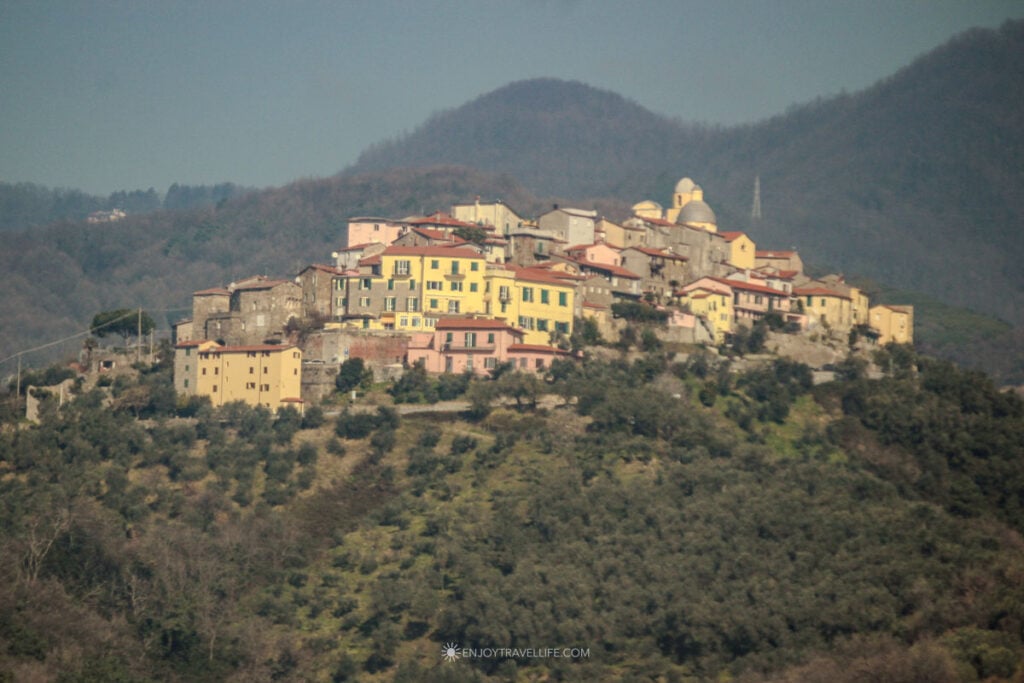
Sit on the right side of the train (facing the direction of travel) for the best views of the Italian countryside.
The train ride itself is worth paying attention to. You’ll pass the Arno river valley with bare winter trees, Carrara marble quarries in the Apuan Alps, and hilltop villages dotting the slopes along the way.
If you’re spending more than a day in Cinque Terre, the Pisa connection is a good excuse to stop for a few hours and explore the city before the second leg.
And when you arrive at La Spezia Centrale, be sure to look up. The station atrium has three frescoes from 1897 by Luigi Agretti, a local painter who was twenty years old at the time. I almost missed them because I was checking my phone.
Where to Stay in Cinque Terre
If you can swing it, stay overnight. You’ll have more time to wander and less time on trains.
For a winter visit, Riomaggiore and Manarola are the best base options. They’re smaller, quieter than Monterosso, and closest to the sunset views.
Use the interactive map below to browse accommodations across all five villages. You can filter by price, dates, and amenities.
A few things to keep in mind for winter bookings: not all rentals have heating, so ask before you book. Some restaurants close or reduce hours in the off-season, so a kitchen can be a lifesaver.
What to Expect in Cinque Terre in Winter
The biggest surprise about visiting Cinque Terre in the off-season? It’s still busy.
I went in February expecting quiet villages and empty trails. The restaurants had waits. The trains between towns were full. The viewpoints had company.
If you’re picturing yourself alone on a cliffside, adjust your expectations.
Not every restaurant will be open in the off-season, but that’s not necessarily a loss. The places that close are the ones that cater to summer tourists. The ones that stay open serve the people who actually live there, and the food is usually better for it.
February along the Ligurian coast is cool and unpredictable. I had a clear day with good light, but rain is common. Average highs are around 50–55°F (10–13°C). So, along with wearing comfortable shoes, pack layers and a waterproof jacket.
The upside is that winter light photographs well, and the lemon trees give the landscape color that summer heat burns away.
When I visited Cinque Terre, several trails between towns were closed for landslide repairs. The famous Via dell’Amore (Path of Love) connecting Riomaggiore to Manarola fully reopened in August 2024 after 12 years of work.
It now requires timed-entry tickets (capacity is 400 per hour). As of March 2026, access is included in the Cinque Terre Card, but you still need a reservation.
One more thing. The public bathroom situation is rough, especially off-season when some facilities are closed. I encountered one of the worst restroom situations of my entire time in Italy.
You’ll want to use the restrooms at the train station or a restaurant before you start exploring, and don’t count on finding a clean public option along the way.
Pack a small pack of tissues or travel toilet paper. Public restrooms in Cinque Terre are scarce, especially in winter, and the ones that exist don’t always have supplies. Trust me on this one.
Three Towns in One Day: What You’ll See
Cinque Terre is five villages strung along a few miles of Ligurian coastline, each one different. Start in Riomaggiore and work your way north. The scenery builds as you go.
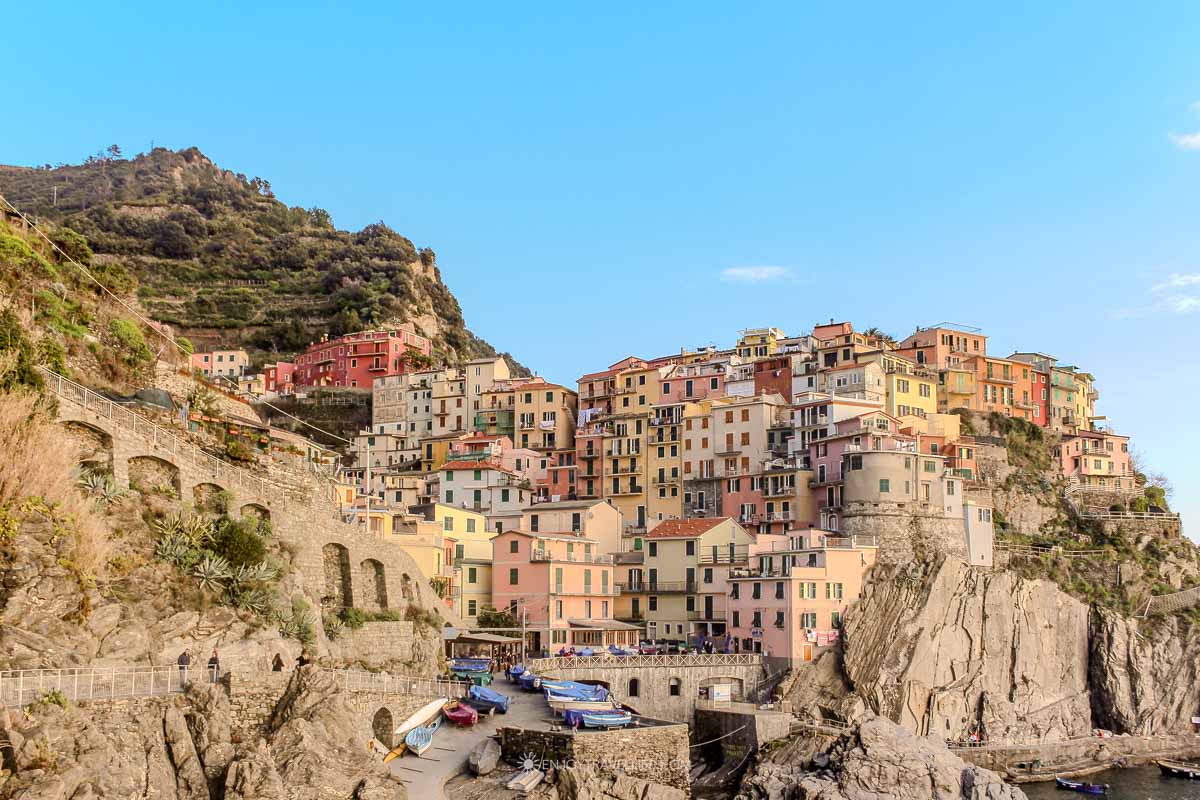
Riomaggiore is the southernmost, with colorful buildings stacked up a steep hillside and a rocky harbor at the bottom. Manarola has the classic panoramic view you’ve seen in every Cinque Terre photo. Corniglia sits on a hilltop above the sea, the quietest of the five, reached by a 382-step staircase from the train station. Vernazza has a sheltered natural harbor, a medieval watchtower, and the most relaxed feel. Monterosso al Mare is the largest, with the only real sandy beaches and more of a resort atmosphere.
I visited three of the five by train: Riomaggiore, Manarola, and Vernazza. Each one is just a few minutes apart by the Cinque Terre Express.
Here’s what to expect in each.
Riomaggiore
If ever a place makes a breathtaking first impression, Cinque Terre is it. Before you even reach the village of Riomaggiore, the cliffs drop into turquoise water and you’re stopping to take photos on the coastal walkway.
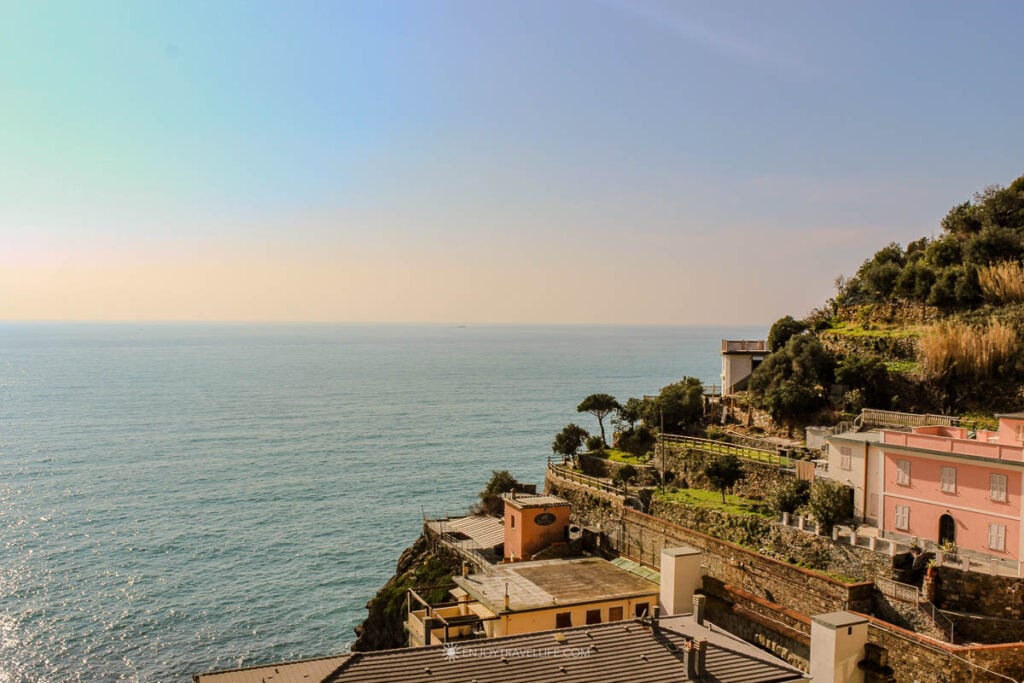
You enter through a pedestrian tunnel decorated with stone mosaics by the artist Silvio Benedetto. The shaped tiles and glazed panels depict the history of the coast.
Then you step out into the village.
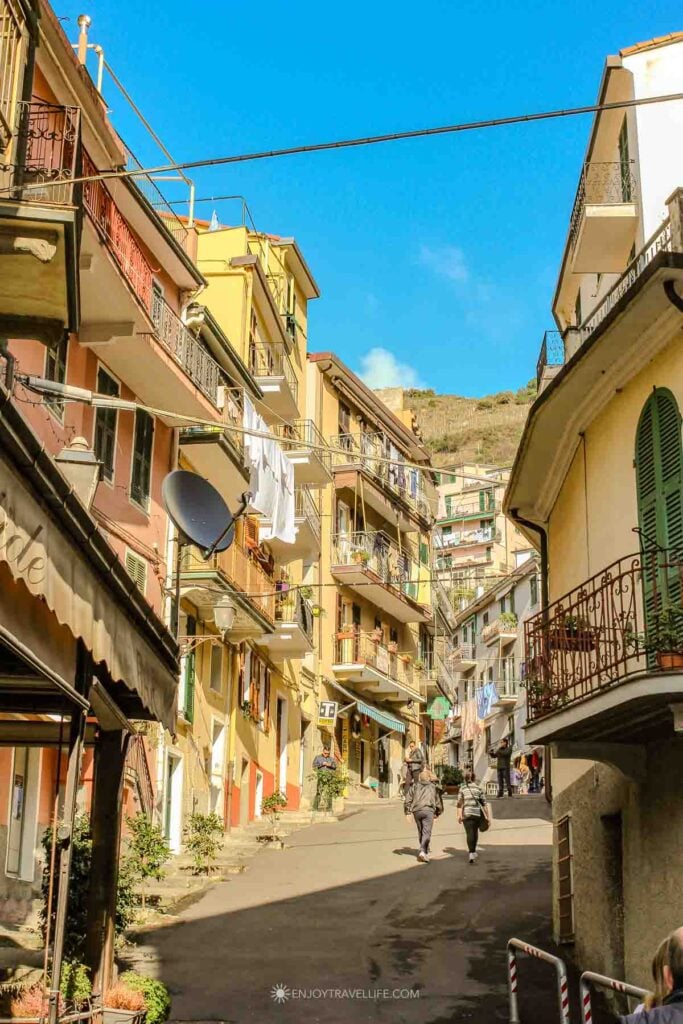
The buildings stack up the hillside at precarious angles, and as you walk up through narrow lanes, the views open wider with every turn.
Prickly pear, spurge, and yucca grow wild along the hillside.
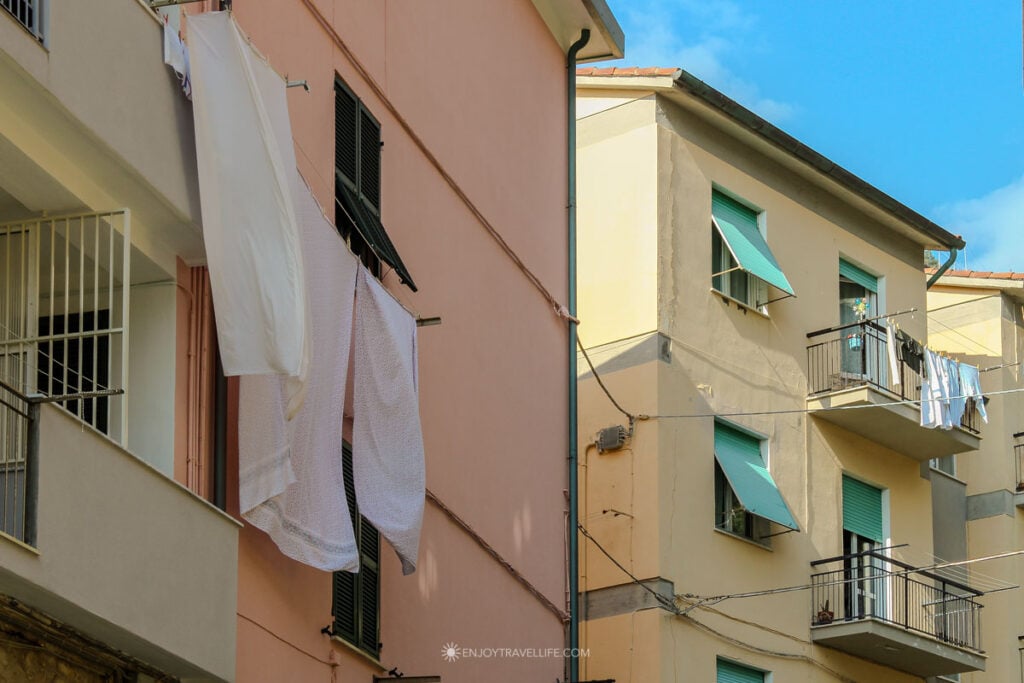
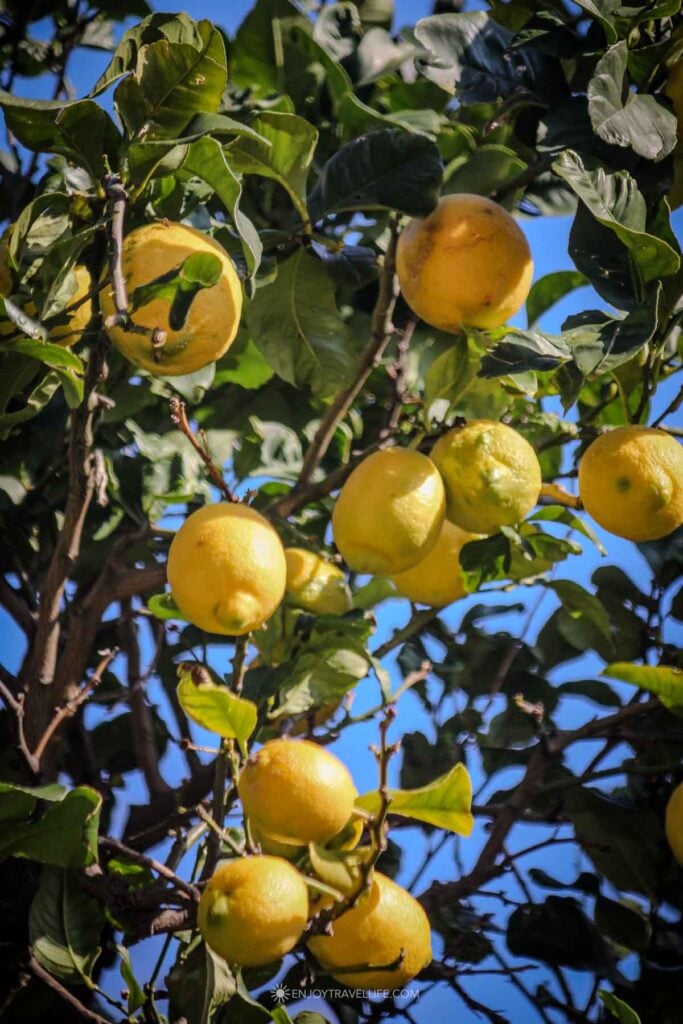
On Via Colombo, the main street, laundry hangs between pink and cream buildings and lemon trees are heavy with ripe fruit even in February. You’ll find this street lined with small shops selling colorful ceramics (good keepsakes) and local limoncello.
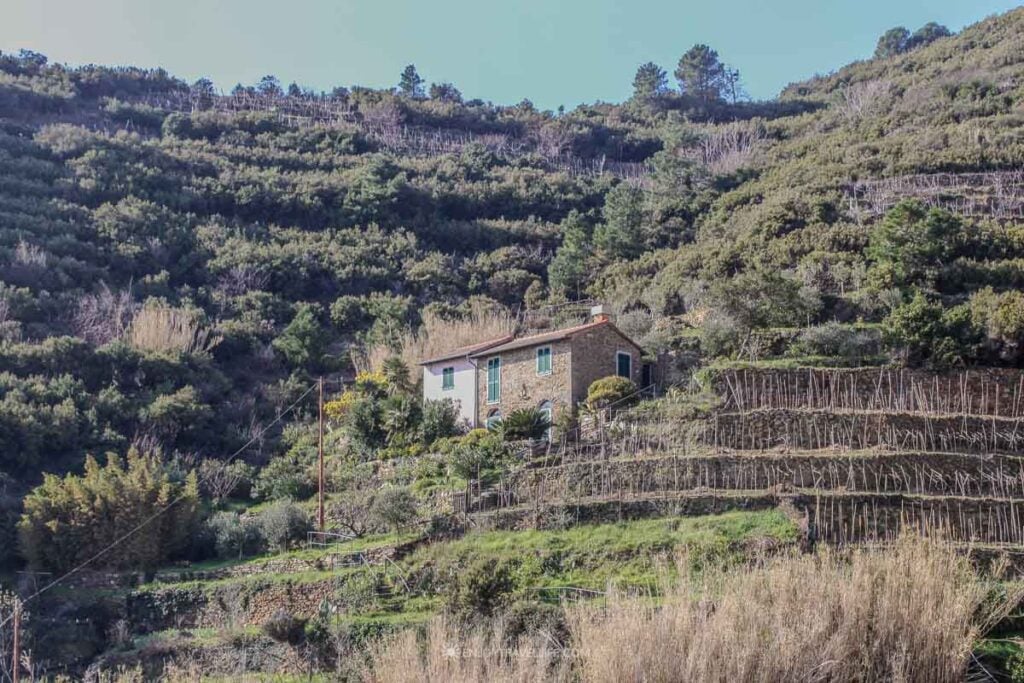
The terraced hillsides above the village are vineyards, and if you see Sciacchetrà on a menu, order it. It’s a sweet dessert wine local to this coast, made from grapes dried on those same terraces.
At the bottom of Riomaggiore, near the harbor, there’s a small opening in the rocks where you can reach the water. I took my shoes off and put my toes in the Tyrrhenian Sea in February. Cold, but worth it if you like collecting oceans.
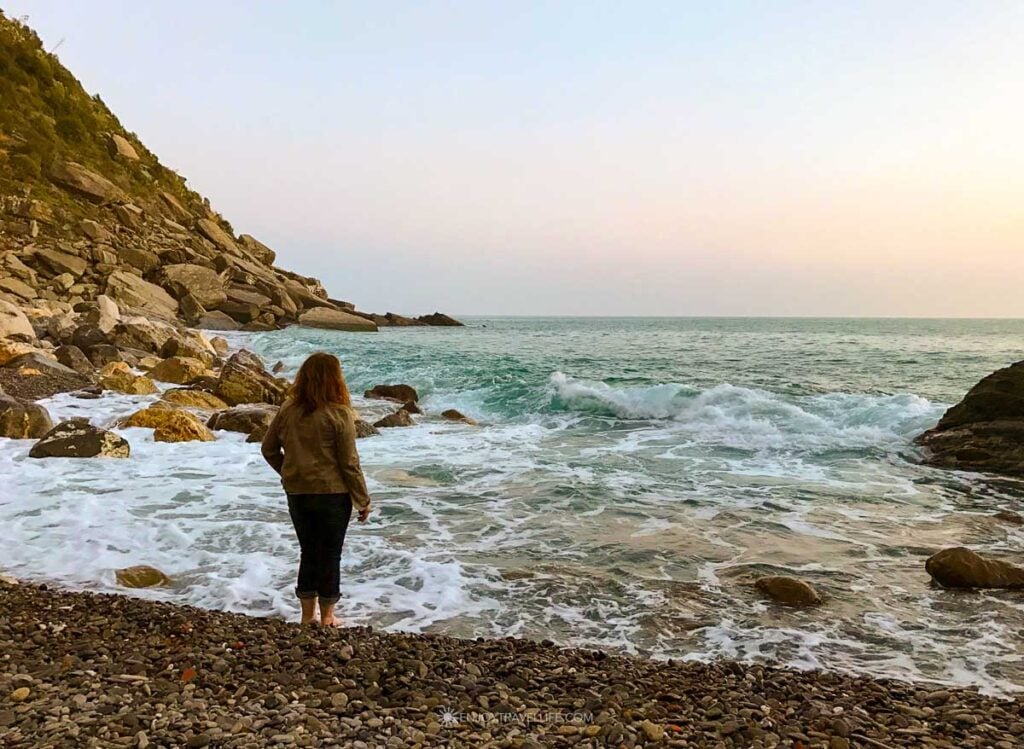
I spent about an hour and a half in Riomaggiore before catching the train to Manarola. If you have more time, here are a few things worth seeking out:
- Church of San Giovanni Battista. A 14th-century Gothic church near the top of the village with a rose window and striped stone facade typical of Ligurian architecture.
- Sanctuary of Montenero. A hilltop sanctuary above Riomaggiore with panoramic coastal views, reached by trail or steep road.
- Riomaggiore Harbor. The dramatic rocky harbor lined with colorful houses is one of the most photographed scenes in Cinque Terre.
Manarola
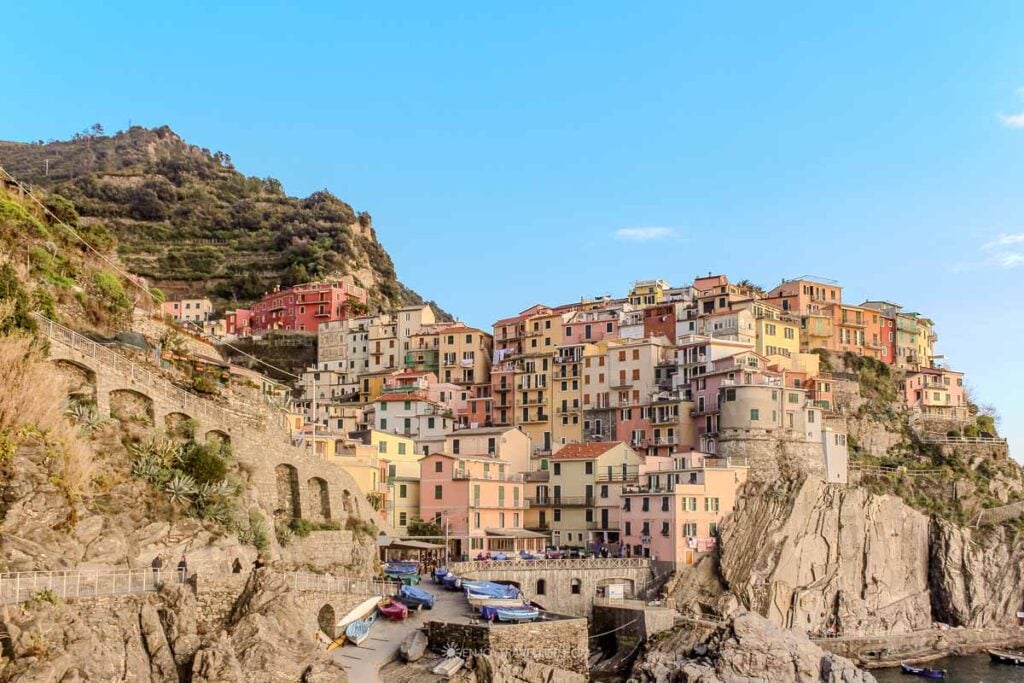
Manarola has the single best panoramic view of the five villages. If you take one photo in Cinque Terre, take it here.
You arrive by walking through a tunnel from the train station and step into Piazza Dario Capellini, where stone mosaics are set into the ground beneath your feet. From there the village drops downhill toward the harbor.
The famous viewpoint is along the cliffside path above the harbor. From there you can see the full scene in one frame: pastel buildings cascading down to a tiny harbor with fishing boats below.
Walk down to the cliffside path early in your visit so you know where to come back to if the light changes.
If you want a waterfront table, put your name in early and explore while you wait. In February I waited a while, but that patience comes easier when you’re watching fishing boats in a Ligurian harbor.
When my table was ready, it was worth the wait. The wine and limoncello poured freely, the trofie di castagne, the chestnut pasta this coast is known for, and the water views made for an experience I’ll never forget.
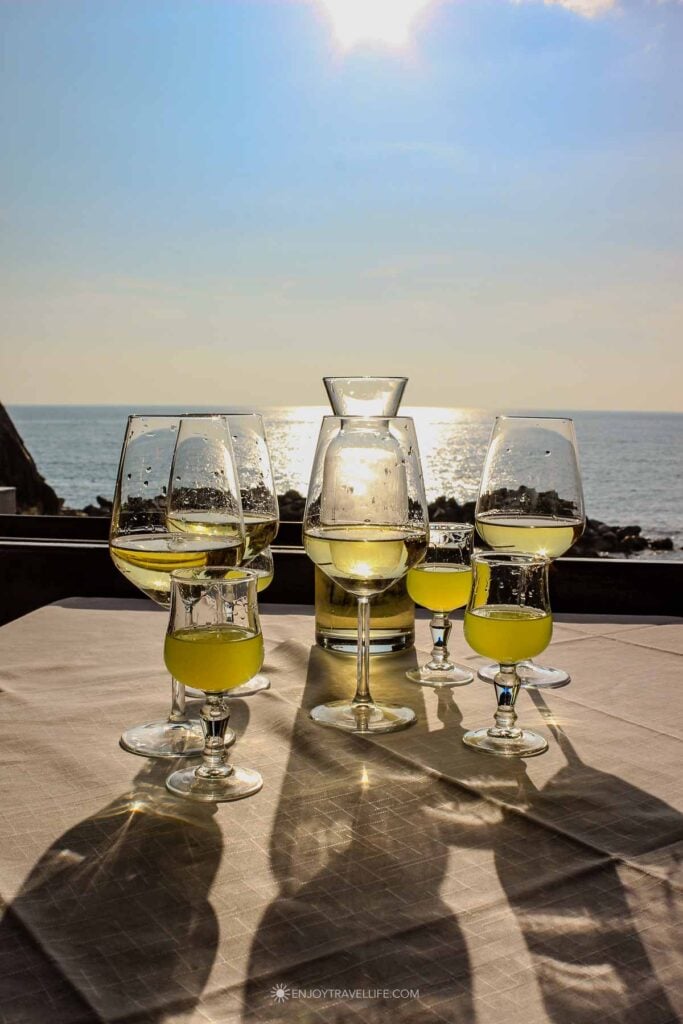
I spent about two hours in Manarola, the longest stop of the day. The last of it was waiting for the train, watching the sun drop behind iron railings silhouetted against the water.
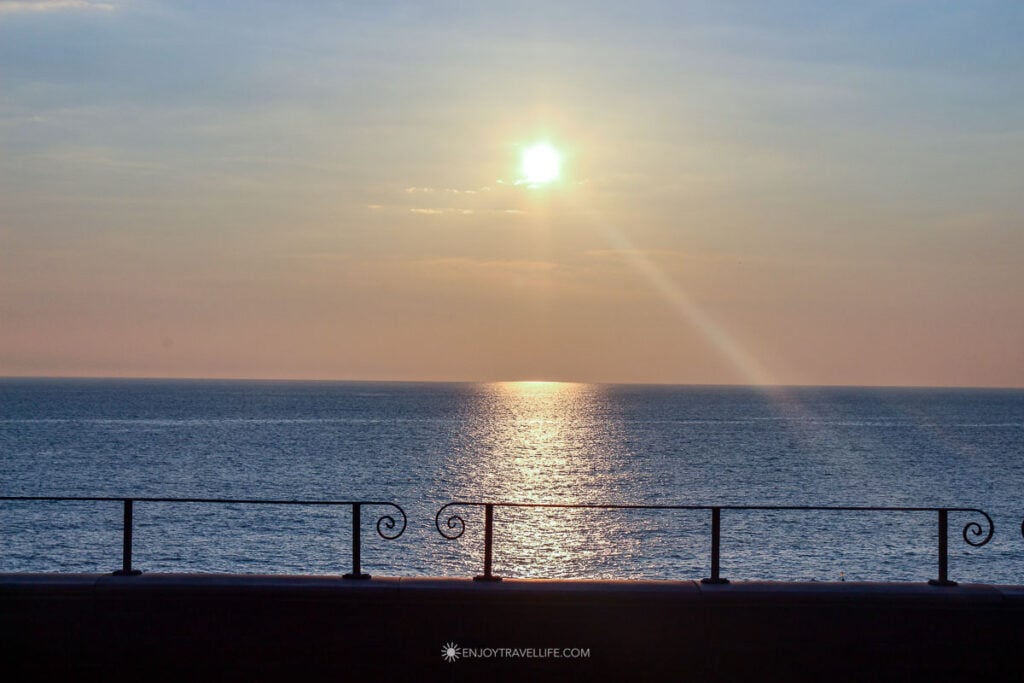
If you have more time, a few things worth seeking out in Manarola:
- Manarola Scenic Overlook. The cliffside path above the harbor provides the classic panoramic view seen in most Cinque Terre photography.
- Church of San Lorenzo. A Gothic Ligurian church dating to the 14th century with a rose window and detached bell tower.
- Punta Bonfiglio Walkway. A scenic waterfront path popular at sunset with benches, viewpoints, and rocky sea access.
Vernazza
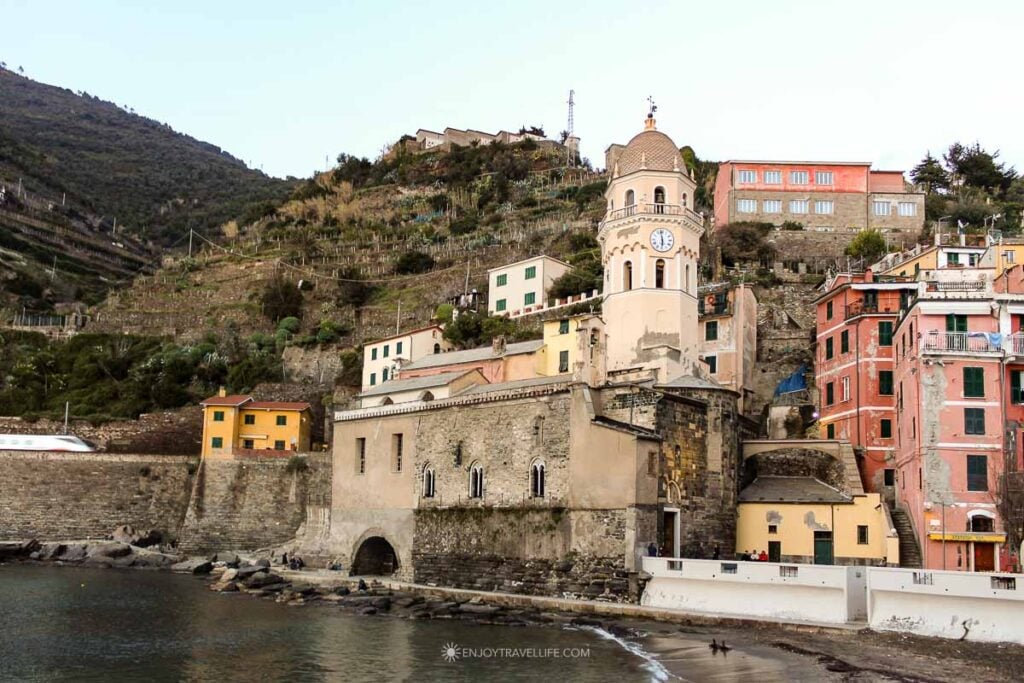
I arrived in Vernazza at twilight and walked fast, down the main street, past an old wooden door, past the pebble mosaic sun and wave pattern set into Piazza Marconi, and straight to the harbor rocks to catch the last of the sunset.
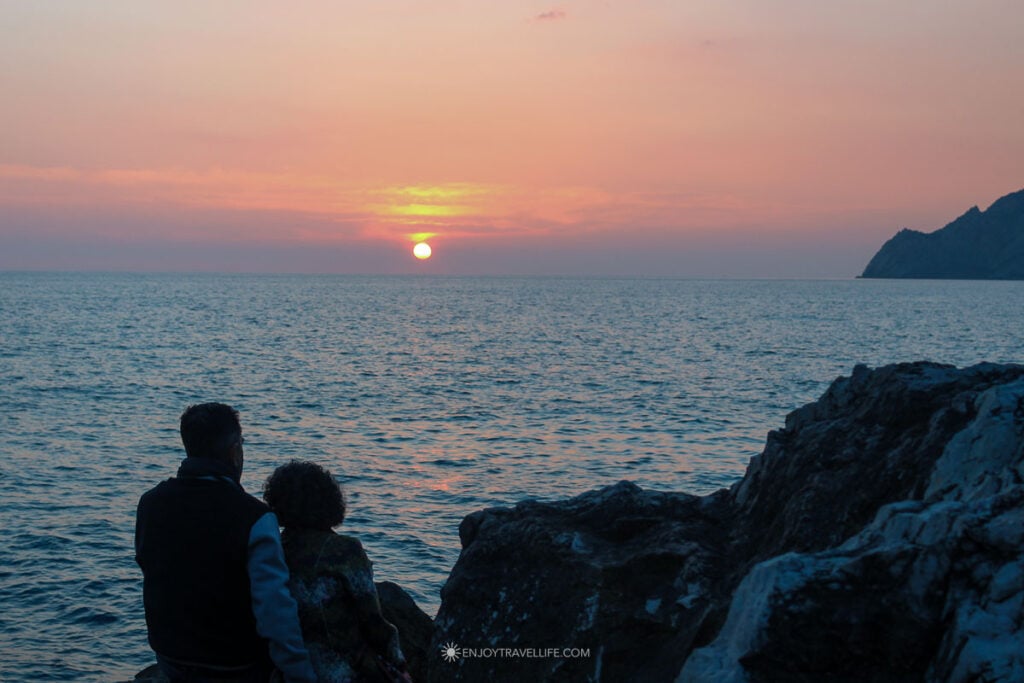
I made it just in time. A couple sat silhouetted on the rocks, watching the sun drop into the Tyrrhenian.
Vernazza has a natural harbor that’s more sheltered than the other villages, with a sandy beach area and waterfront restaurants. Of the three towns, it felt the most relaxed.
If your timing works out, plan to be at the harbor rocks around sunset. The light turns the water gold, then pink, and couples gather on the stone walls and benches to watch it happen. It’s one of the more romantic spots on the coast, and it doesn’t feel staged.
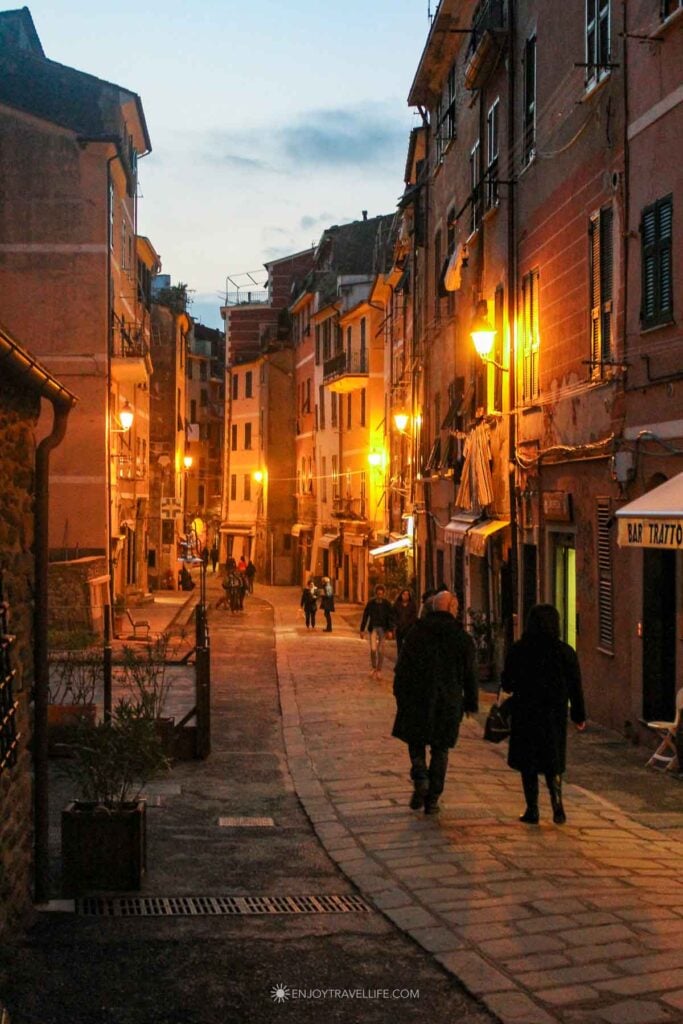
After dark is worth staying for.
Walking the back streets and connected alleys by the waterfront, it’s easy to imagine what this village looked like centuries ago.
I found the Chapel of Santa Marta almost by accident, a small stone chapel that looks misplaced in the street yet is perfectly belonging, lit softly behind an iron grille. It was the kind of thing you only find because you stayed past the comfortable hour.
I spent about an hour in Vernazza before catching the return train via La Spezia. If you have more time, a few things worth seeking out:
- Castello Doria. A medieval defensive tower overlooking the harbor with sweeping coastal views.
- Church of Santa Margherita d’Antiochia. A seaside church built directly beside Vernazza’s harbor with a distinctive octagonal bell tower.
- Vernazza Harbor. The natural harbor, lined with fishing boats and waterfront restaurants, is one of the most atmospheric gathering spots in the region.
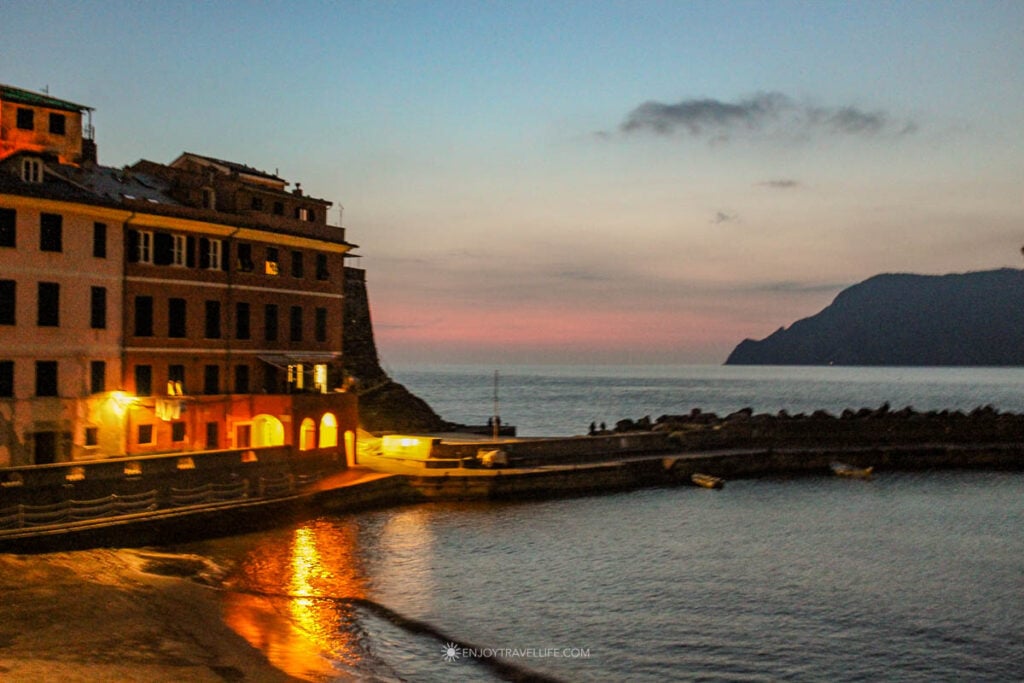
After the sun went down, the village changed. The streets filled with warm lamplight, the church tower stood against a pink sky, and the harbor reflected the lights of the buildings above it. I found a small chapel tucked into the stone, barely marked, lit softly behind an iron grille. It was the kind of thing you only find because you stayed past the comfortable hour.
I spent about an hour in Vernazza before catching the return train via La Spezia. If you have more time, a few things worth seeking out:
- Castello Doria. A medieval defensive tower overlooking the harbor with sweeping coastal views.
- Church of Santa Margherita d’Antiochia. A seaside church built directly beside Vernazza’s harbor with a distinctive octagonal bell tower.
- Vernazza Harbor. The natural harbor, lined with fishing boats and waterfront restaurants, is one of the most atmospheric gathering spots in the region.
Two Towns I Skipped: Corniglia & Monterosso al Mare
Three villages was the right number for a day trip from Florence, but if you’re staying overnight or just want to know what you’re skipping, here’s what’s in the other two.
Corniglia
Corniglia is the only village that sits on a hilltop instead of at the water. From the train station, you either climb the Lardarina staircase (382 steps) or take a shuttle bus up.
It’s the smallest and quietest of the five, surrounded by terraced vineyards instead of harbor restaurants. If you want the least crowded Cinque Terre experience, this is it.
- Lardarina Staircase: 382 steps connecting the train station to the village. It’s a workout, but the views on the way up are worth the effort.
- Church of San Pietro: A 14th-century Ligurian Gothic church with a rose window and marble carvings, often considered the most beautiful church in Cinque Terre.
- Terraced Vineyards: Corniglia is known for the vineyards that wrap around the village above the sea, where the local Sciacchetrà wine has been produced for centuries.
Monterosso al Mare
Monterosso is the largest of the five towns, with sandy beaches, beachfront hotels, and more of a classic seaside resort feel. If you’re traveling with kids or want a place to spread out a towel, Monterosso is the practical choice.
- Il Gigante (Neptune Statue): A massive weathered statue carved into the rocks near Fegina Beach. It was built in the early 1900s and damaged by storms, but what remains is still striking.
- Monterosso Beaches: The largest sandy beaches in Cinque Terre. In summer they fill with umbrellas and sunbathers, but in winter you can walk the shoreline with almost no one around.
- Capuchin Monastery and Church of San Francesco: A hilltop monastery above the village with coastal views and artwork inside, including a painting attributed to Van Dyck.
- Old Town Medieval Tower: Part of the original coastal fortifications, now a landmark you can spot from the waterfront promenade.
What to Eat in Cinque Terre in Winter
The must-try is trofie di castagne (chestnut pasta). It’s a traditional Ligurian specialty with roots that go back centuries. In the mountains above the coast, where the terrain was too steep for wheat, chestnut trees were the main crop. Locals milled the nuts into flour and made pasta from it. Ordering it in February means eating it in its actual season.
Other dishes to look for:
- Pesto alla Genovese – Liguria is its birthplace, and the local version is different from what you get at home.
- Fresh seafood – Anchovies, mussels, and whatever came in that morning.
- Focaccia di Recco – Thin, crispy, stuffed with soft cheese.
- Farinata – Chickpea flatbread, served hot. Simple and good.
- Limoncello – Made from the lemons you’ll see growing everywhere. Don’t leave without trying it.
Is a Day Trip to Cinque Terre Worth It?
Honestly? Yes, with a caveat. You will not see everything, and you will get home late. But the afternoon and evening I spent on this coast was one of the best days of the trip.
I had ten days to cross Italy from Venice down to Positano. Most places got a day, maybe two. Cinque Terre got one, and I packed it full.
Here’s how the day actually played out.
1-Day Itinerary for Cinque Terre
| Time | What |
|---|---|
| ~11:00 AM | Pastry and takeaway coffee for breakfast at Florence Santa Maria Novella, then train toward the coast. |
| ~12:50 PM | Carrara marble quarries and hilltop villages visible from the train window. |
| ~1:45 PM | Arrived La Spezia Centrale. Three frescoes in the station atrium by a local painter, almost missed them checking my phone. Changed to the Cinque Terre Express. |
| ~2:30 PM | Arrived Riomaggiore. Walked the terraced hillsides, Via Colombo, lemon trees and laundry between the buildings. Toes in the Tyrrhenian at the pebble beach. |
| ~4:00 PM | One-stop train to Manarola. Lunch at a waterfront restaurant overlooking the harbor. Limoncello on the table, fishing boats below. |
| ~5:30 PM | Walked down to the Manarola harbor viewpoint for the classic village-on-the-cliff photo. |
| ~6:00 PM | Waiting for the train out of Manarola. Iron railings silhouetted against the water, last light on the coast. |
| ~6:40 PM | Train to Vernazza. Walked fast through the piazza and down to the harbor rocks just in time to catch the last of the sunset over the water. |
| ~7:15 PM | Vernazza at twilight. Pebble mosaics in the piazza, the church tower against a pink sky, lamplit streets, harbor reflections. |
| ~8:00 PM | Return train from Vernazza via La Spezia. |
| ~11:00 PM | Back in Florence. Long day, no regrets. |
That is a long day. About five hours of train, five and a half hours in the villages. If that ratio bothers you, stay overnight.
But here is what that ratio bought me: I arrived in Riomaggiore when the afternoon light was golden and warm. I had limoncello in Manarola while the sun dropped over the harbor. And I walked into Vernazza at the exact moment the sky turned pink and the streetlights came on.
If I had caught a 7 AM train and arrived at 10, I would have had more hours but worse light and midday shadows on every west-facing building on the coast.
Trying to squeeze in all five villages in a day trip would have meant 20 minutes per town and a lot of running for trains.
Riomaggiore, Manarola, and Vernazza gave me a full afternoon with room to sit down, eat a real meal, and stay somewhere long enough to notice things.
Could I have used another day? Absolutely.
Would I skip it if a day trip was all I had? Not a chance.
7 Tips for Visiting Cinque Terre in Winter
1. Buy train tickets in advance. Regional trains between Florence, Pisa, and La Spezia fill up around holidays and Carnival. Book your Florence connection ahead of time.
2. Watch the clock. In February, sunset comes around 5:30 PM. Factor in train transfers, a long lunch, and the temptation to linger, and your daylight goes faster than you think.
3. Order the chestnut pasta. Trofie di castagne is the traditional winter pasta of this coast. You’re eating local history. Ask for it.
4. Bring cash. Some smaller shops and restaurants are cash-only. ATMs exist but aren’t plentiful.
5. Use the restrooms strategically. The public bathroom situation is rough, especially off-season when some facilities are closed. Go when you can.
6. Book Via dell’Amore tickets. The Path of Love requires timed-entry reservations, even in winter. Capacity is 400 per hour. As of March 2026, it’s included in the Cinque Terre Card.
7. Stay overnight if you can. I did it as a day trip and wouldn’t again. Three towns in one day, bookended by two and a half hours of train each way, left us rushing. If your schedule allows, book a night.
Final Thoughts on Cinque Terre in Winter
Cinque Terre in winter is not empty, not always sunny, and not the lazy coastal stroll you might be imagining. It’s also one of the most unexpectedly rewarding winter destinations I’ve visited in Italy.
My mother’s only memory of her grandmother, my great-grandmother Otina who came to America from a small village in southern Italy, is sitting at her feet beside the stove. Otina held up a nickel. “Cinque,” she said.
Cinque Terre. “Five lands.” The name didn’t mean much to me until I was standing on the shore of one. More than a hundred years later, Ottina’s great-granddaughter was counting coastlines instead of coins.
Go to Cinque Terre in winter. Just plan to stay longer than I did, if you can.

FAQs about Cinque Terre in Winter
Is Cinque Terre worth visiting in winter?
Yes. The crowds are smaller (though not gone), the winter light is beautiful for photography, and seasonal dishes like chestnut pasta make the food experience special. You’ll miss swimming and some trails may have limited hours, but the villages have a quieter, more local feel.
Can you do Cinque Terre as a day trip from Florence?
You can. The train takes about two and a half hours each way with a change in Pisa. But I’d recommend staying overnight if possible. A day trip gives you enough time for two or three towns, a meal, and sunset, but you’ll feel rushed.
How do you get from Florence to Cinque Terre by train?
Take a regional train from Florence Santa Maria Novella to Pisa Centrale or La Spezia Centrale, then connect to the Cinque Terre Express trains. The Cinque Terre Card covers unlimited rides between the towns.
Is Via dell’Amore open in 2026?
Yes. It fully reopened in August 2024. It requires timed-entry tickets and reservations. As of March 2026, access is included in the Cinque Terre Card, but you still need to reserve a slot. Capacity is 400 per hour.
What should you eat in Cinque Terre in winter?
The must-try is trofie di castagne, a chestnut flour pasta that’s a traditional winter specialty. Pesto, fresh seafood, focaccia, and farinata are available year-round. Finish with limoncello.
Next Steps
For more on planning your trip to Italy, read these articles next: